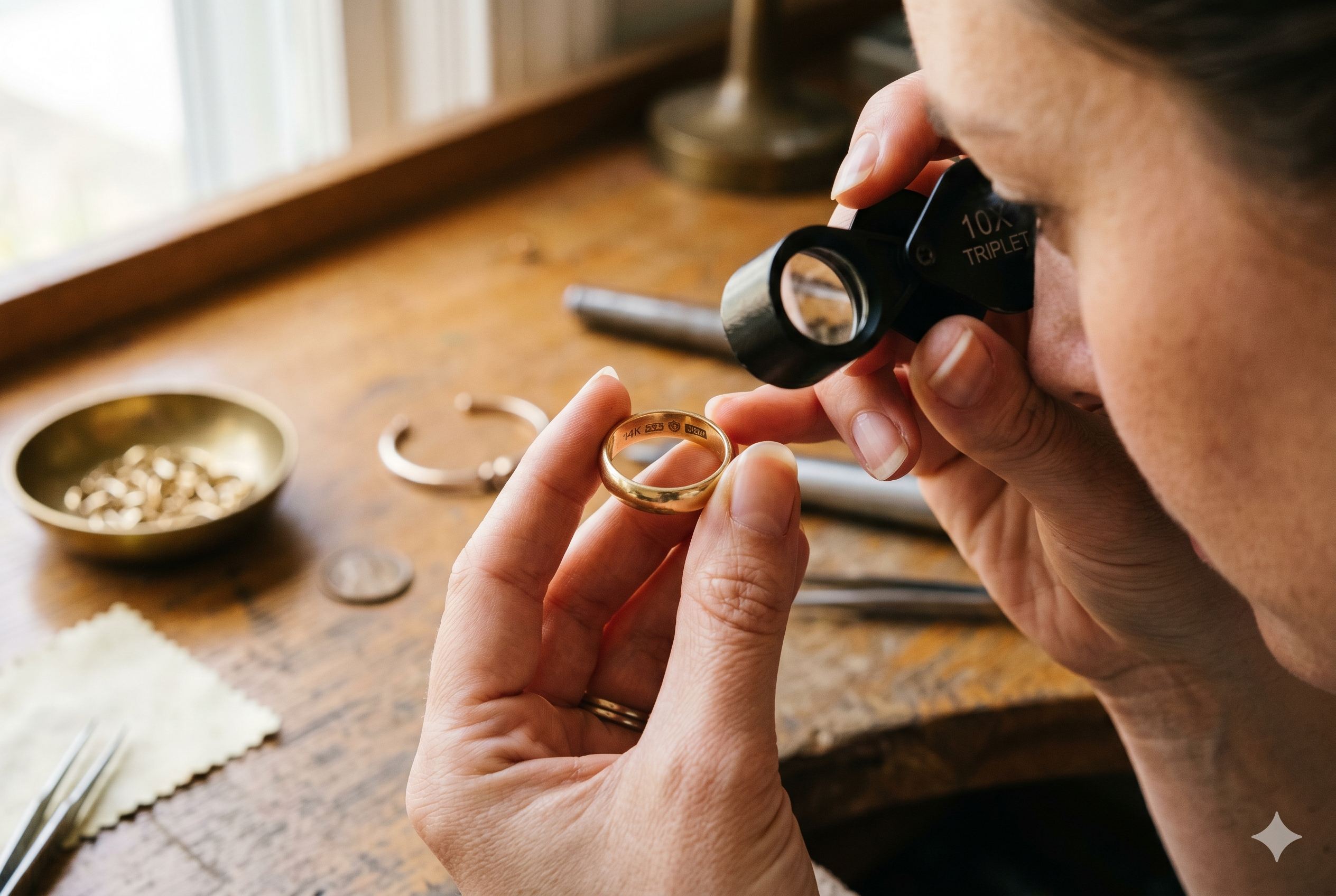
How to Read the Tiny Stamps on Your Gold Jewelry: A Complete Guide to Hallmarks
Grab a ring, a necklace, or a bracelet from your jewelry box and look at it closely. Somewhere on that piece — usually in a spot you’d never notice unless you were looking for it — there’s almost certainly a tiny stamp. These stamps are called gold hallmarks, and learning to read them is one of the most reliable ways to know what your jewelry is actually made of.
Before you ever pick up a magnet or drop something in a glass of water, understanding gold hallmarks will answer a lot of your questions right away. Here’s everything you need to know.
Where to Look
Gold hallmarks are always placed somewhere discreet. The manufacturer doesn’t want them to interfere with how the piece looks. So you’ll need to hunt a little, and a magnifying glass or your phone’s camera zoom helps a lot.
Common spots:
- Rings — inside the band, usually opposite the stone or the top of the design
- Necklaces and bracelets — on or right next to the clasp, on the tag that hangs near the clasp, or on a jump ring
- Earrings — on the post (for studs) or on the back of the earring near the hook or clip
- Pendants and charms — on the back, near the bail (the loop the chain goes through), or on the edge
- Watches — on the inside of the case back, often with a lot of other stamps
Older pieces sometimes have stamps that have worn down over decades of wear. If the stamp looks faint or you can only make out part of it, try tilting the piece under a bright light — that usually makes worn stamps readable again.
Gold Hallmarks in the Karat System (U.S. Standard)
In the U.S., gold purity is most often stamped using the karat system. Pure gold is 24 karat, and everything else is a ratio: the number tells you how many parts out of 24 are pure gold.
Here’s what each common stamp means:
- 24K — 99.9% pure gold. Very rare in jewelry because it’s too soft for daily wear.
- 22K — 91.6% gold. Common in Indian, Middle Eastern, and Asian jewelry. Soft but beautiful.
- 18K — 75% gold. High-end jewelry standard. Holds its shape well and has a rich color.
- 14K — 58.5% gold. The most common gold jewelry stamp in the United States. Durable and affordable.
- 10K — 41.7% gold. The minimum that can legally be called “gold” in the U.S. Very durable.
You might also see unusual karat stamps like 12K or 9K on older or imported pieces. 9K is common in British and Australian jewelry and is about 37.5% gold.
The European System (Numbers in the Hundreds)
Gold from Europe, and increasingly from modern U.S. manufacturers too, is often stamped with a three-digit number instead. This is called the millesimal fineness system, and it tells you the gold content in parts per thousand.
These numbers match up directly with the karat stamps above:
- 999 — 24K (99.9% pure)
- 916 — 22K (91.6%)
- 750 — 18K (75%)
- 585 — 14K (58.5%)
- 417 — 10K (41.7%)
- 375 — 9K (37.5%)
If you see “750” stamped inside a ring, that’s the same thing as 18K. Don’t let the unfamiliar number throw you off.
Stamps That Mean It’s NOT Solid Gold
This is where hallmarks become really valuable. There are specific stamps that tell you, definitively, that a piece is not solid gold. If you see any of these, the item has real gold on the outside but a different metal underneath.
- GP — Gold Plated. A very thin layer of gold over a base metal.
- GEP — Gold Electroplated. Same idea, applied with an electric current.
- HGE or HGP — Heavy Gold Electroplate. A thicker plating than standard GP, but still plating.
- RGP — Rolled Gold Plate. Older technique, mechanical bonding of a thin gold sheet to base metal.
- GF — Gold Filled. This one’s interesting — the layer is much thicker than plating (at least 5% of the item’s total weight must be gold), but it’s still not solid gold.
- 1/20 12K GF — This type of stamp tells you the proportion and karat of the gold layer. Here, 1/20 of the weight is 12K gold.
- Vermeil (sometimes stamped as “925” alongside gold coloring) — Sterling silver with a gold plating on top.
These stamps are not worthless items — gold-filled pieces in particular have real value and a substantial gold layer. But they shouldn’t be confused with solid gold, and they’re priced very differently.
Other Gold Hallmarks You Might See
Beyond the purity stamp, you’ll often find additional marks near it. These are normal and usually a good sign — they point to a piece from a reputable maker.
- Maker’s mark — a small logo, initials, or symbol identifying the company that made the piece. Think of it like a signature.
- Assay office mark — in countries like the UK, an official government mark certifying the purity. Common symbols include a crown, leopard’s head, anchor, or castle, each tied to a specific city.
- Date letter — on UK and European pieces, a letter indicating the year the piece was hallmarked.
- Country of origin — stamps like “Italy,” “750 Italy,” or “Made in USA.”
If a piece has a purity stamp plus a maker’s mark plus an assay mark, that’s a very strong indicator of authenticity. Forgers can fake one stamp, but faking the whole set convincingly is much harder.
A Few Important Cautions
Gold hallmarks are useful, but they’re not magic. Here’s what to keep in mind:
No stamp doesn’t always mean fake. Older pieces — especially pre-1960s American jewelry, handmade pieces, and some antique items — were never stamped in the first place. A missing stamp just means you need to use other methods to verify it.
Stamps can be faked. Lower-quality counterfeits sometimes have fake stamps on them. A “14K” stamp on a piece that’s actually brass is not unheard of. That’s why the stamp is a starting point, not a final answer.
Stamps can wear down. Fifty or sixty years of wear can rub a stamp almost smooth. Don’t assume an unreadable stamp means the piece is fake.
Plating stamps sometimes fade. Ironically, the “GP” or “GF” stamps on plated items sometimes wear off faster than the plating does, which can make an old plated piece look unmarked and confuse things.
What to Do With This Information
Once you know how to read gold hallmarks, you can sort your own jewelry into three groups pretty quickly:
- Clearly marked solid gold (10K, 14K, 18K, 22K, 24K, or 375/585/750/916/999)
- Clearly marked plated or filled (GP, GEP, HGE, GF, RGP, etc.)
- Unmarked or unclear — worth a closer look with other methods or a professional eye
If you’re curious about a piece — whether it’s something you inherited, found in a jewelry box, or picked up along the way — the easiest next step is to bring it in and let someone take a proper look. At our weekly buying events, we examine items with professional testing equipment that reads the actual metal content, not just the stamp. We explain what we find, answer your questions, and there’s no charge to have something evaluated.
Even if you’re not looking to sell, it’s a nice way to finally know what you actually have.
Premier Gold, Silver & Coin holds weekly buying events in hotels across the country. Stop by, bring your questions, and find out what your items are really worth. [Check our schedule to see when we’ll be in your area.]