Morgan Silver Dollar: America’s Iconic Silver Coin (1878‑1921)
When you hold a Morgan Silver Dollar in your hand, you hold a piece of American history. Struck from 1878 to 1904 and again for a single year in 1921, this coin marked the return of standard silver dollars after the Coinage Act of 1873 and quickly became a symbol of the late‑19th‑century United States. It’s story intertwines with the Bland–Allison Act, debates over free silver, frontier mints such as Carson City and New Orleans, and the artistry of engraver George T. Morgan. In this article, you’ll discover how the Morgan Dollar was born, how its design encapsulates America’s aspirations, and why collectors still treasure it.
Origins: The Bland–Allison Act and the push for silver
The Coinage Act of 1873 ended free coinage of silver and halted the Seated Liberty dollar, angering miners and farmers who wanted an inflated money supply. Their lobbying led to the Bland–Allison Act of 1878, which required the U.S. Treasury to buy millions of dollars’ worth of silver each month and convert it into dollars. To fulfill this mandate, the mint needed a new design. George T. Morgan, then an assistant engraver, was chosen to create the new dollar that now bears his name .
A quick timeline:
-
1878 – First Morgan Dollars struck at Philadelphia, San Francisco and Carson City mints. The coin contained 412½ troy grains of 90 % silver (0.77344 troy ounces).
-
1880s–1890s – Continuous minting under the Bland–Allison Act; production levels shifted based on silver purchases.
-
1904 – Mint’s silver supply depleted; Morgan Dollar production stops.
-
1921 – Brief revival after the Pittman Act ordered millions of silver dollars melted and recoined.
-
1960s – Uncirculated bags discovered in Treasury vaults; collectors hoard them.
-
2021–present – Modern commemorative issues honor the centennial of the final Morgan Dollar.
Designing Liberty and the eagle: symbolism on each side
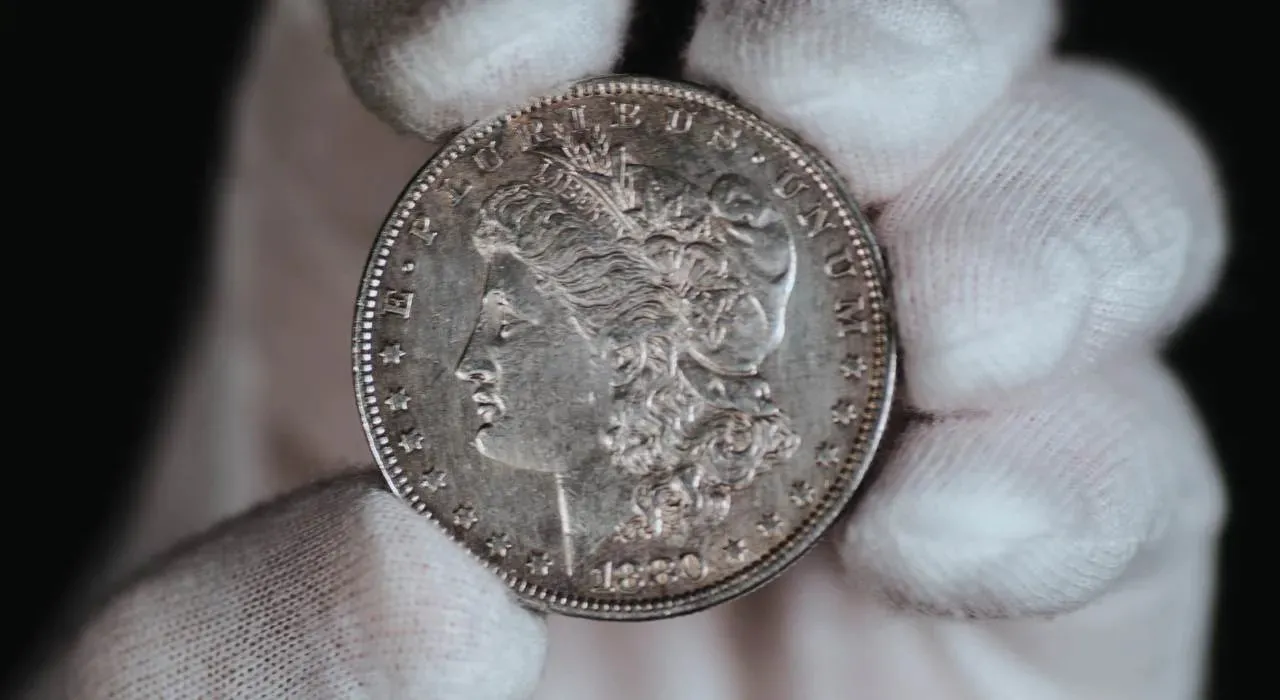
George T. Morgan wanted the new dollar to represent the vigor of an industrializing nation. The obverse features a profile portrait of Liberty modeled after Philadelphia schoolteacher Anna Willess Williams . She wears a Phrygian cap—a symbol of freedom—decorated with wheat and cotton, representing American agriculture. The legend E Pluribus Unum arcs above, and thirteen stars circle Liberty to honor the original states.
The reverse showcases a heraldic eagle with outstretched wings clutching arrows and an olive branch, symbolizing strength and peace. The eagle is surrounded by a wreath and flanked by the inscriptions “In God We Trust,” “United States of America,” and “One Dollar,” elements that underscored the coin’s national significance. Morgan’s design balanced classical beauty with the rugged optimism of the post‑Civil War era.
Where Morgan Dollars were struck: mint marks and scarcity
Mint marks on the Morgan Dollar reveal where it was made. The first dollars were struck at Philadelphia (no mint mark), Carson City (“CC”), San Francisco (“S”), and New Orleans (“O”). Later issues came from Denver (“D”). These letters appear on the reverse above the “DO” in Dollar.
Coins from certain facilities are especially prized. The Carson City Mint, built in 1863 to process silver from Nevada’s Comstock Lode, operated only until 1893 and produced about 56.6 million coins. Its limited output and sporadic closures (it shut down entirely from 1886–1888) make CC‑marked Morgan Dollars scarce. New Orleans minted silver dollars intermittently; it closed in 1909 after producing significant quantities. Because of these constraints, coins with CC or O mint marks—especially low‑mintage dates like the 1893‑CC and 1889‑CC—command substantial premiums.
Economic forces: silver booms and policy shifts
The Morgan Dollar existed at the heart of the 19th‑century silver controversy. Mining interests wanted unlimited silver coinage to expand the money supply, while proponents of sound money feared inflation. The Bland–Allison Act partially satisfied silver miners but was replaced by the Sherman Silver Purchase Act of 1890, which increased government silver purchases but required coinage for only one year.
When silver prices fell and the U.S. economy entered the Panic of 1893, Congress repealed the Sherman Act. In 1904, with bullion stocks depleted, Morgan Dollar production ceased. Millions of coins were later melted under the Pittman Act of 1918, yet the Act also mandated that replacement dollars be struck, leading to the single-year 1921 mintage.
Modern rediscovery and renewed popularity
In the early 1960s, Treasury vaults yielded thousands of bags of uncirculated Morgan Dollars. Collectors rushed to exchange silver certificates for these coins, sparking a modern appreciation for Morgan Dollars and causing prices to rise sharply. The U.S. Mint capitalized on this popularity by selling Carson City coins through the General Services Administration in the 1970s.
Recently, the Mint has issued commemorative Morgan Dollars beginning in 2021, preserving the original designs while using 99.9 % silver rather than the historic 90 % alloy. The 2021 release marked the coin’s centennial, and subsequent issues continue to attract collectors seeking a link to America’s past.
Collecting Morgan Dollars: tips and notable dates
-
Focus on key dates and mint marks. The 1889‑CC, 1893‑CC and 1895 Morgan Dollars are famous rarities. Low mintage numbers and the melting of many examples make these coins exceptionally valuable.
-
Check the condition. Coins are graded on a 70‑point scale. Uncirculated (MS60 and higher) examples command higher prices, especially with appealing luster and minimal bag marks.
-
Beware of counterfeits. Popular dates attract forgeries. Purchase from reputable dealers and consider certification by PCGS or NGC.
-
Understand historical context. Morgan Dollars are tangible reminders of debates over silver and gold, western mining booms and early U.S. monetary policy. Their story enriches any collection.
Stories of survival: a hoard rediscovered
A famous example of Morgan Dollar allure is the Treasury hoard. In the early 1960s, a clerk at the U.S. Treasury discovered sealed bags of uncirculated Carson City Morgan Dollars forgotten in the vaults. Word spread, and collectors lined up to exchange paper silver certificates for the silver coins. The frenzy revealed not only the U.S. public’s enthusiasm for silver but also highlighted how many Morgan Dollars had survived untouched for decades. Many of the coins from the hoard later entered collections, fueling interest in CC‑marked dollars and raising awareness of mint marks.
How this coin connects to other collectibles
The Morgan Silver Dollar bridges the worlds of numismatics and broader collectible history. Its design and mint marks inform our understanding of industrial America and monetary politics. When evaluating other collectibles—whether Civil War memorabilia, vintage jewelry or sports artifacts—look for similar provenance stories. Items tied to specific places or eras, like a Morgan Dollar with a Carson City mint mark or a Victorian brooch, often carry added historical value.