Sterling Silver Flatware: A Seller’s Guide to Patterns, Weight, and Maker’s Marks
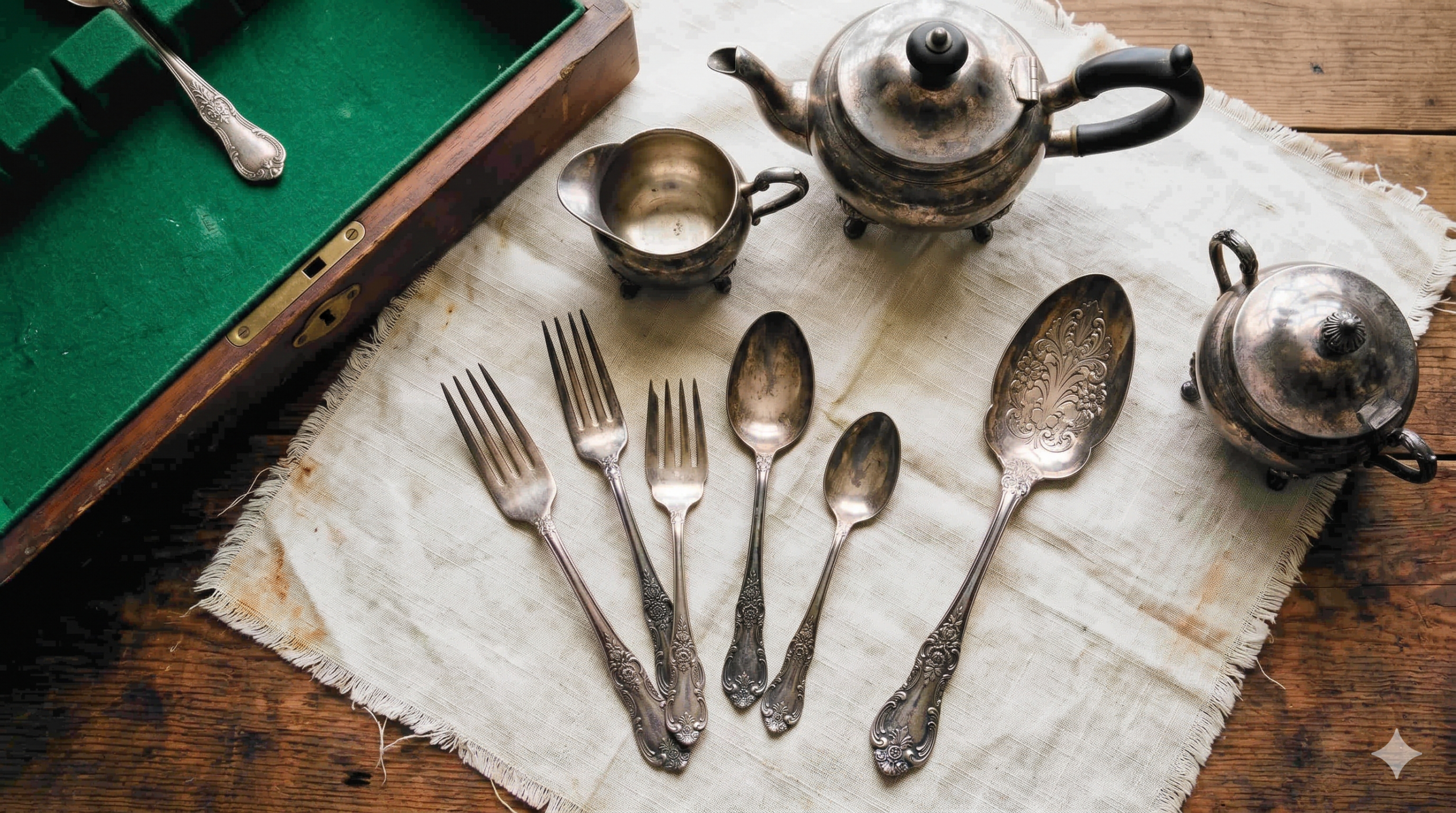
Sterling silver flatware is one of the most common items people inherit and then have no idea what to do with. It sits in a closet for years, wrapped in tarnish-stained cloth, taking up space — too valuable to throw away, too inconvenient to actually use.
If you’re at the point of selling, there’s a wide range of what your set might actually be. Some sterling flatware sets are worth a few hundred dollars in silver content. Some are worth several thousand because of the maker, the pattern, or the weight. And some pieces that look identical to sterling at a glance are actually silverplate — worth essentially nothing on the resale market.
Here’s how to tell the difference and prepare to sell.
Step one: confirm it’s actually sterling
The single most important distinction in your set: sterling silver vs. silverplate.
Sterling silver is 92.5% pure silver alloyed with copper for strength. It has real, melt-value worth based on weight.
Silverplate is a thin layer of silver electroplated onto a base metal (often nickel or brass). The silver layer is too thin to economically recover, which means silverplate flatware — regardless of how attractive or how old — has essentially zero scrap value.
How to tell which you have:
- Look at the back of each piece, near the handle base. Sterling will be marked with one of: “STERLING,” “.925,” “925/1000,” or “925.”
- Silverplate marks include “EP,” “EPNS” (electroplated nickel silver), “Silver Plate,” “Silver on Copper,” “A1,” “Triple Plate,” “Quadruple Plate,” or brand names like “1847 Rogers Bros.” without a sterling marking.
- British sterling uses a series of hallmarks: a lion passant (walking lion) confirms sterling purity, plus city marks, date letters, and maker’s marks. Older British silver follows the same 92.5% standard.
If you find a piece marked anything other than sterling, silver content, or a verified British hallmark — it’s almost certainly plated. Set it aside.
Important: Don’t dismiss an entire set because some pieces are silverplate. Some inherited collections mix sterling serving pieces with silverplate everyday flatware, or vice versa. Sort piece by piece.
Step two: identify the maker
American sterling silver flatware was produced by a handful of major makers, and the maker affects desirability. Some of the most common:
- Gorham (Providence, RI) — one of the largest and longest-running American sterling makers
- Reed & Barton (Taunton, MA) — major maker with hundreds of patterns
- International Silver Company — formed from a merger of several Connecticut makers
- Towle (Newburyport, MA) — high-end patterns including the popular Old Master and King Richard
- Wallace — known for the Grand Baroque pattern, one of the most collected
- Lunt — quality maker with patterns like Eloquence
- Tiffany & Co. — Tiffany sterling commands significant premiums above standard sterling pricing
- S. Kirk & Son — Baltimore maker known for Repoussé designs
The maker’s mark appears next to the sterling stamp. If you’re unsure, photograph the marking and a knowledgeable buyer can identify it quickly.
Step three: identify the pattern
Pattern matters because of the replacement market. A piece of common pattern flatware is worth its silver weight. A piece of a discontinued or sought-after pattern can be worth multiple times its silver weight to a replacement service.
Some patterns that historically command premiums:
- Wallace Grand Baroque (1941–present)
- Towle Old Master (1942)
- Towle King Richard (1932)
- Reed & Barton Francis I (1907)
- Gorham Chantilly (1895)
- Gorham Strasbourg (1897)
- International Royal Danish (1939)
- Tiffany Chrysanthemum (1880)
- Tiffany English King (1885)
Patterns are usually marked by name on the underside of each piece. If unmarked, the design itself identifies it — pattern reference guides exist for every major maker.
The takeaway: don’t assume your set is worth only its silver weight without checking the pattern. A buyer who knows flatware will check pattern automatically; a buyer who weighs everything and quotes melt value isn’t doing the work.
Step four: understand the weight question
Sterling silver is sold by weight, but the way weight works on flatware has a wrinkle.
Solid pieces (forks, spoons, butter knives) are pure sterling throughout. Their full weight counts.
Hollow-handle pieces (most dinner knives, some serving pieces) have a sterling handle wrapped around a non-silver core — usually plaster, pitch, or stainless steel. Only the silver weighs, not the filler. A buyer will deduct the filler weight when calculating offer.
This is normal industry practice, not a tactic. But it’s why an inherited set of flatware that weighs 200 ounces total might only have 120 ounces of actual sterling content. The math works out, but you should understand it before you walk into an offer.
Weighing at home: A kitchen scale that measures in grams gives you a useful estimate. Weigh the solid pieces separately from the hollow-handle pieces. Multiply solid-piece weight × 0.925 × current silver spot price for a rough melt benchmark. Hollow-handle is harder to estimate without disassembly.
Step five: don’t worry about tarnish, do worry about damage
Tarnish does not reduce value. A buyer expects to see tarnish on inherited flatware — it confirms the pieces haven’t been mistreated and the silver hasn’t been mishandled. Don’t polish your flatware before selling. Aggressive polishing can remove microscopic amounts of silver over time and damage soft details on patterned pieces.
What does reduce value:
- Monograms. Personalized initials engraved on the front of pieces lower value to replacement buyers (who can’t resell monogrammed items easily). The pieces still have silver content, but won’t command pattern premiums.
- Damage. Bent tines, cracks, missing pieces, deep scratches, repaired joints — all reduce value.
- Polishing damage. Old over-polishing that’s softened pattern details or thinned the silver is visible to a buyer.
- Stainless tines on knives. Most hollow-handle dinner knives have stainless steel blades — this is normal and doesn’t hurt value. Stainless tines on forks, however, are a sign of repair or replacement.
What to bring when selling
When you’re ready to have a sterling silver set evaluated:
- Bring the entire set together — buyers can offer better when they see a complete service vs. scattered pieces.
- Bring the storage chest or box if you have it, especially if it has the maker’s name. Pattern identification is easier with original boxes.
- Include serving pieces. Sterling serving spoons, ladles, carving sets, and oddities (cheese knives, asparagus servers, bouillon spoons) can carry strong premiums in popular patterns.
- Don’t sort out monogrammed pieces — bring them. Even monogrammed sterling has silver value.
- Bring any paperwork — old invoices, gift cards, maker certificates, or replacement service records.
Realistic expectations on offers
A wholesale offer for sterling flatware reflects:
- Silver content (weight × purity × spot percentage)
- Pattern premium (when applicable, for sought-after patterns)
- Maker premium (for Tiffany, Kirk Repoussé, etc.)
- Condition deductions (monograms, damage)
- The buyer’s resale path — whether they sell to a refinery or to a replacement service like Replacements, Ltd.
What you won’t get from a wholesale offer:
- Retail replacement value (what it would cost to rebuild your set new today)
- Auction high estimates
- Sentimental value
That’s not unique to flatware — it’s how the wholesale market works for any precious-metal item. The trade-off is same-day, no-fee, no-listing payment vs. the time investment of trying to sell pieces individually online.
Selling sterling flatware to Premier
Premier Gold, Silver & Coin evaluates sterling flatware at weekly buying events across the Midwest and Mid-Atlantic. Bring the full set — chest, serving pieces, monogrammed pieces, everything — and we’ll walk through it pattern by pattern, weighing solid pieces and accounting for hollow-handle filler transparently. Offers are paid by business check the same day. Sign up for local notifications to know when we’re in your area.
Sterling flatware that’s been sitting in a closet for decades can be a meaningful sale. It can also be a modest one. But you won’t know which until someone who handles silver every day takes the time to identify what’s actually in front of them.