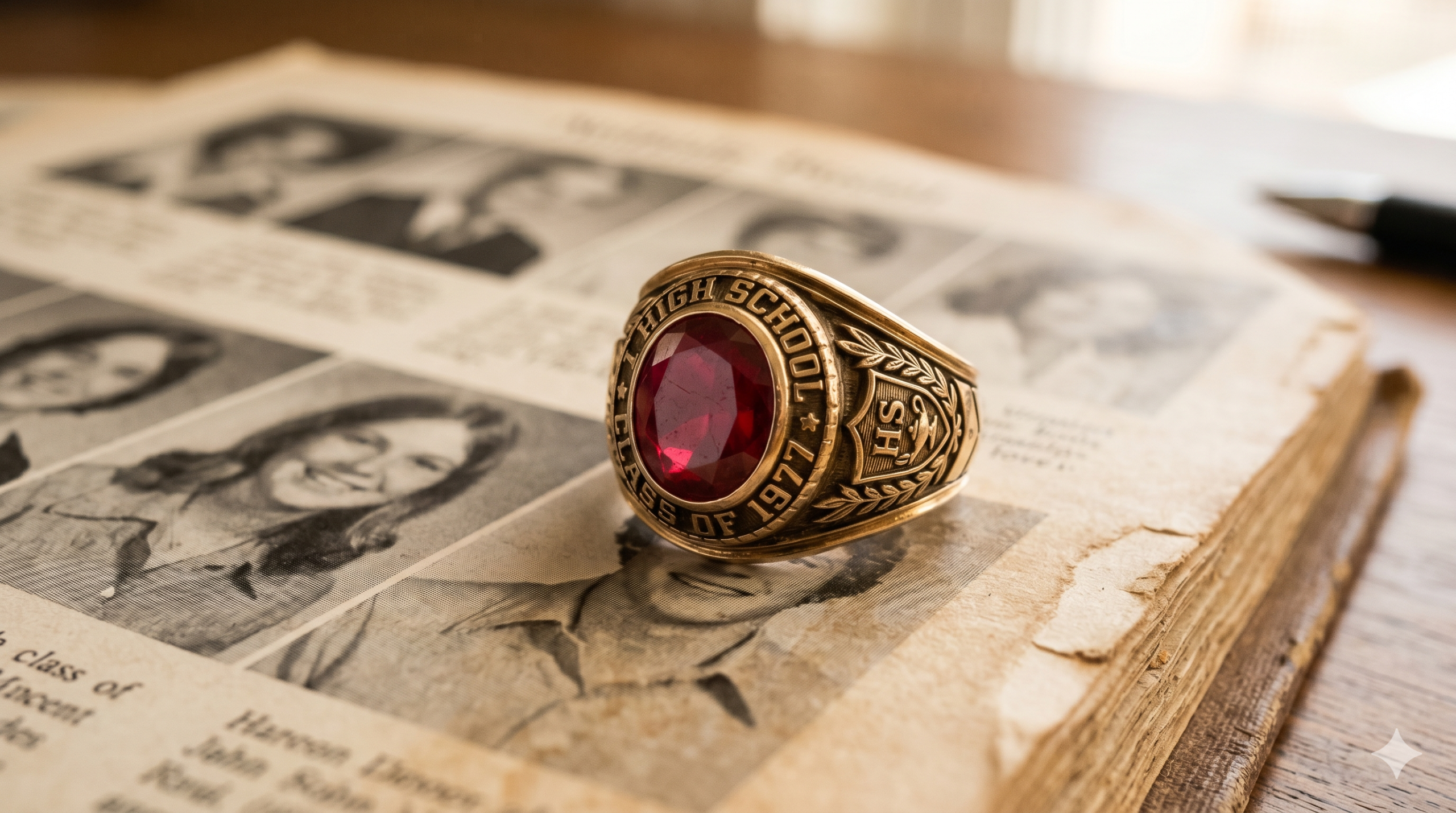
Selling a Gold Class Ring: What to Know Before You Go
You’ve had it in a drawer for years — maybe decades. A gold class ring from your own high school or college, or one that belonged to a parent or grandparent. The gold class ring sits there because it feels too valuable to throw away but isn’t something you’ll ever wear again.
The good news: most gold class rings have real, recoverable value. They’re solid gold, they’re heavy, and they’re one of the easier items for a buyer to evaluate quickly. Here’s what determines what you’ll actually be offered — and what to know before you walk in.
First check: is your gold class ring actually gold?
Class rings come in several flavors, and only some are gold:
- Solid gold — usually 10k, sometimes 14k. Has real melt value.
- Gold-filled — a thick gold layer mechanically bonded to a base metal core. Marked “GF” or “1/20 10K GF” or similar. Limited resale value.
- Gold-plated / gold electroplated — a thin layer of gold over a base metal. Marked “GE,” “GEP,” or “HGE.” Essentially no resale value.
- Lustrium, Siladium, Celestrium — proprietary white metal alloys used by major class ring makers (Jostens, Balfour, Herff Jones) for less-expensive rings. Not gold. No precious-metal content. Often look similar to white gold but contain no silver or gold.
How to tell what you have: look inside the band. Class rings are almost always stamped on the inner band with their metal content. You’ll typically see:
- “10K” — solid 10-karat gold (most common for class rings)
- “14K” — solid 14-karat gold (less common, higher-end rings)
- “18K” — solid 18-karat gold (rare for class rings, usually special order)
- “10K GF” or similar — gold-filled, not solid
- “Lustrium” or another brand name — proprietary alloy, no precious metal
If there’s no stamp at all, the ring may still be gold but unmarked rings are unusual on class rings. A buyer can test the metal in about 30 seconds to confirm.
10k is the standard for most gold class rings
The vast majority of American class rings are 10-karat gold. 10k contains 41.7% pure gold (the rest is alloy metals — copper, silver, zinc, nickel). It’s the minimum karat that can legally be called “gold” in the United States.
A 10k class ring sounds like less precious metal than a 14k or 18k piece — and it is. But class rings are heavy. A typical men’s 10k class ring weighs 15–30 grams. A women’s runs 8–15 grams. That meaningful weight, even at 41.7% purity, adds up to real melt value at current gold prices.
Stones rarely add value
A gold class ring almost always features a center stone — and almost none of these stones add resale value:
- Synthetic stones. Most class ring stones are lab-created (synthetic ruby, synthetic spinel, lab sapphire, lab amethyst, etc.). They’re durable and attractive but have minimal resale value.
- Glass / paste stones. Some older or budget class rings use glass.
- Real diamonds — uncommon on class rings but occasionally found, especially on high-end gold rings from the 1950s–70s. Even when present, they’re typically small (under 0.10 carat) and contribute modest value.
- Birthstone stones — typically synthetic versions of the corresponding birthstone color.
Buyers will almost always offer based on the gold weight, not the stone. The stone may be removed during refining, or the ring may be melted with stone in place. Either way, don’t expect a stone premium unless you have documentation suggesting it’s a genuine valuable gem.
Weight is the biggest variable
Two 10k gold class rings can have very different values based purely on weight. A petite women’s ring might weigh 8 grams. A heavy men’s ring with a thick band can weigh 30+ grams. That’s a 4x difference in gold content — and a 4x difference in offer.
To get a rough estimate before you go:
- Weigh the ring on a kitchen scale that measures in grams
- Multiply by the karat purity (10k = 0.417, 14k = 0.585, 18k = 0.750)
- Multiply by the current gold spot price per gram
- Multiply by the buyer’s payout percentage (varies, but reputable buyers pay a significant percentage of melt)
This won’t give you the exact offer, but it’ll tell you whether an offer is in the right ballpark.
Engravings, inscriptions, and personalization
The inside of class rings often has engravings — names, dates, school information. These are normal and do not reduce value for a buyer who’s purchasing for melt. The ring goes to a refinery regardless of what’s engraved inside.
Some engravings might be of historical interest (rare schools, unusual graduation dates, military academies) but in most cases the engraving is irrelevant to the offer.
Vintage gold class rings
Class rings from before roughly 1950 have a slightly different profile:
- More likely to be 14k than 10k
- Often thinner and lighter than modern class rings
- May feature real (small) diamonds or gemstones in some high-end pieces
- Sometimes have collectible interest beyond gold value — military academy rings (West Point, Annapolis, Air Force Academy) from specific eras can have premiums to specialized collectors
- Engravings may add historical context that matters to collectors
If you have an old class ring (pre-1950, especially pre-1930), mention it to the buyer and don’t assume it’s automatically melt-value-only. Some early class rings carry collector demand.
What a fair offer on a gold class ring looks like
A fair wholesale offer for a class ring is calculated transparently:
- Karat purity (verified by acid test, electronic tester, or XRF)
- Weight (measured in front of you on a calibrated scale)
- Current spot price (the buyer should tell you what they’re using)
- Payout percentage (varies by buyer, but transparent buyers will tell you)
- Minus any stone weight if applicable
If a buyer offers a flat number without showing the math, you don’t have enough information to evaluate. A real offer can be walked through line by line.
Mistakes that cost sellers money
Selling without checking the stamp. A “gold-filled” class ring sold under the assumption it’s solid gold won’t get the offer you expect. Five seconds with a loupe or magnifier on the inside band confirms what you have.
Selling at a mall jewelry counter. Many mall jewelers offer class-ring trade-in programs for store credit. The credit is almost always worth less than what you’d get from a dedicated buyer paying cash for your gold class ring.
Cleaning the ring. Class rings are durable and don’t benefit from polishing before sale. Leave them as they are.
Selling individual rings when you have multiple. If you have multiple gold rings, bringing them together gets you a single transaction with a single check — easier than spreading sales across multiple buyers.
Throwing out rings you assumed were costume. Older “graduation rings” from before standardized class-ring marketing are sometimes solid gold even without major stamps. If you’re not sure, bring it in for testing.
What about the sentimental value?
Class rings come with emotional weight. They mark specific years, specific people, specific accomplishments. Selling one feels different from selling a generic piece of jewelry.
A few things worth considering:
- You can keep the stone. Some buyers will remove the stone for you and return it before refining, especially if it has personal meaning.
- You can photograph it. A clear photo preserves the design and any engravings before it’s gone.
- You can hold off. A class ring isn’t going anywhere in your drawer. If you’re not sure, get an offer in writing and decide later. Reputable buyers will hold an offer for at least a few days.
Selling a gold class ring to Premier
Premier Gold, Silver & Coin evaluates gold class rings at weekly buying events across the Midwest and Mid-Atlantic. Bring the ring (or rings), and we’ll test the karat, weigh it, and calculate the offer transparently — math shown, no pressure to decide on the spot. Payment by business check, same day. Find an event near you or sign up for local notifications.
A gold class ring is a small object with a story attached. Take the time to know what it actually is before you let it go.