Mercury Dimes: Key Dates, Grading, and What Sellers Should Know
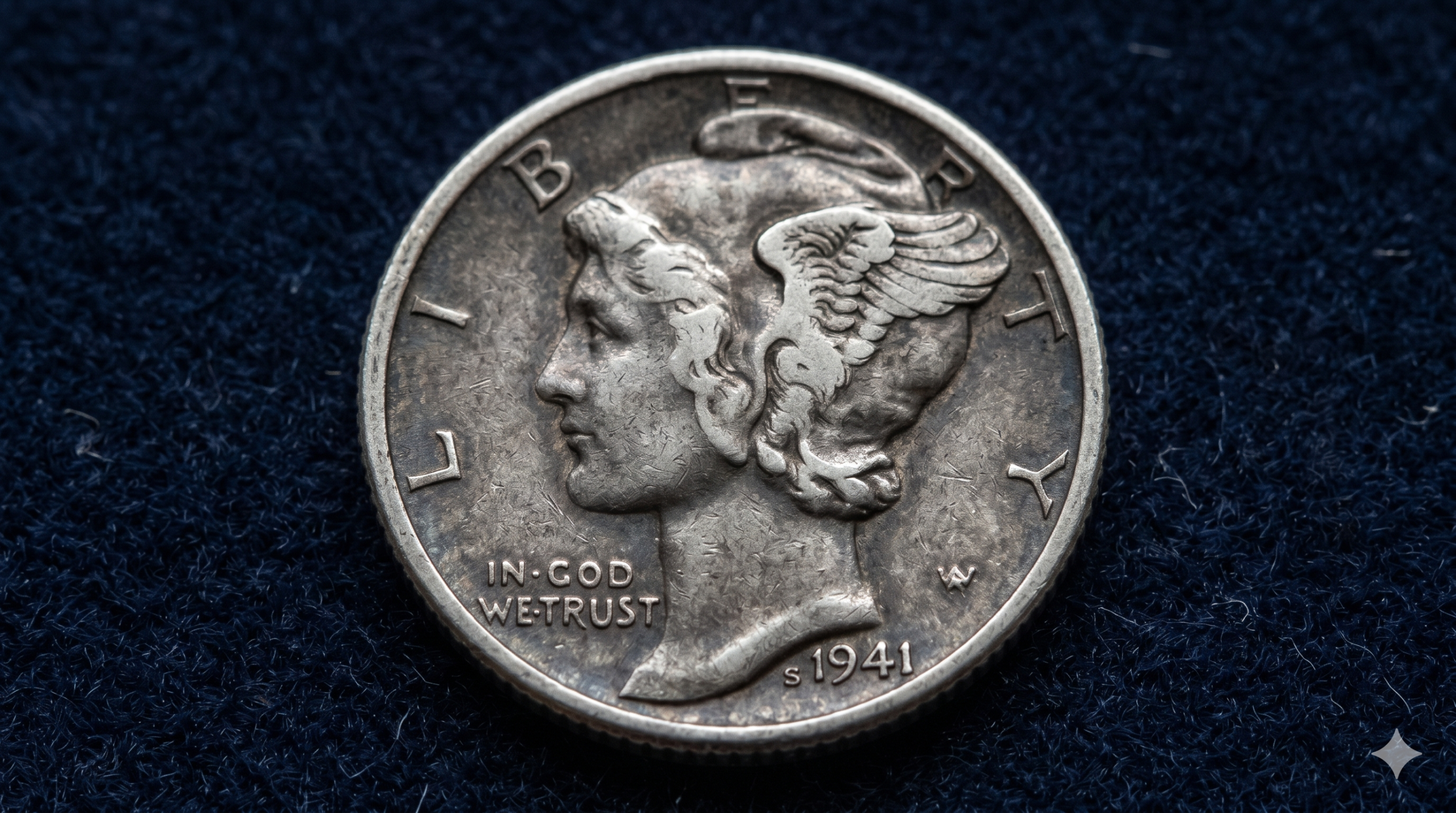
The Mercury dime is one of the most beloved coins ever produced by the U.S. Mint — and also one of the most misunderstood. The “Mercury” name is a mistake; the figure on the obverse isn’t the Roman god Mercury, but a young Liberty wearing a winged cap meant to symbolize freedom of thought. The official name is the Winged Liberty Head dime. But “Mercury dime” stuck, and that’s what nearly everyone calls it.
If you’ve inherited a coin collection, there’s a good chance Mercury dimes are part of it. Most are common-date silver coins worth modest premiums over their melt value. A few are key dates worth hundreds or thousands of dollars even in worn condition. Here’s how to tell the difference and what to know before selling.
The basics
Mercury dimes were minted from 1916 to 1945, replacing the Barber dime and eventually being replaced by the Roosevelt dime. They contain 90% silver and 10% copper, with a weight of 2.5 grams and 0.0723 troy ounces of pure silver.
That silver content is the baseline value of any Mercury dime. Even a heavily worn common-date dime is worth several times face value because of its silver alone.
Three mint locations struck Mercury dimes:
- Philadelphia — no mint mark
- Denver — “D” mint mark
- San Francisco — “S” mint mark
The mint mark appears on the reverse, to the left of the bottom of the fasces (the bundle of rods in the center of the design).
Mercury dime key dates: the ones that matter
Out of the ~28 years and three mints of Mercury dime production, a handful of issues stand out as significantly more valuable than the rest.
1916-D — the king of Mercury dimes
The 1916-D is the lowest-mintage Mercury dime by a wide margin. Only 264,000 were struck — a tiny fraction of typical Mercury dime mintages, which usually ran in the tens of millions. Genuine 1916-D dimes carry significant premiums in every grade, from worn to mint state.
Because of the value, the 1916-D is also the most-counterfeited Mercury dime. A common fake is created by altering a 1916 Philadelphia (no mint mark) coin and adding a fake “D” mint mark. If you have a 1916 dime that looks like it has a D mint mark, don’t assume it’s genuine. Authentication by a qualified buyer or grading service is essential.
1921 and 1921-D — depression-era keys
Both 1921 issues had low mintages. The 1921 (Philadelphia) had 1.2 million minted, and the 1921-D had just 1.08 million. Both command meaningful premiums in any grade.
1942/41 and 1942/41-D overdates
In 1942, dies originally prepared for 1941 were reused with a “2” punched over the “1” — creating a visible overdate. The 1942/41 (Philadelphia) and 1942/41-D are both rare and valuable. The overdate is visible to the naked eye on coins in good condition, with a clear “1” showing beneath the “2” in the date.
If you have a 1942 dime that shows any unusual doubling or visible “1” underneath the “2,” set it aside for evaluation.
Mercury dime semi-key dates
These dates aren’t keys but are scarcer than common dates and worth premiums:
- 1916-S — companion to the 1916-D, much more common but still semi-key
- 1917-D, 1917-S — both moderately scarce
- 1919-D, 1919-S — both semi-keys, especially in higher grades
- 1924-D, 1924-S, 1925-D, 1925-S — mid-1920s D and S issues
- 1926-S — scarcer than most San Francisco issues
- 1931-D, 1931-S — lower mintages during the Depression
The mid-1920s through early-1930s D and S issues are notably scarcer than Philadelphia issues of the same years. If your collection has a lot of “D” or “S” mintmarked dimes from this period, they deserve a careful look.
Common-date Mercury dimes
Most Mercury dimes from 1934–1945 (excluding the 1942/41 overdates) were produced in massive quantities — often 50 to 100+ million per year per mint. These common dates trade at modest premiums above silver melt in average condition. They become more valuable in higher grades, but the bulk of any typical Mercury dime collection sits in this group.
That doesn’t mean common-date dimes are worthless. The silver content alone gives them meaningful value, and large rolls or bags of common-date Mercury dimes are routinely bought and sold.
Full Bands: the grading designation that matters
This is where Mercury dime valuations get interesting.
The reverse of a Mercury dime features a fasces — a bundle of rods bound together, originally a Roman symbol of authority. The bands that wrap the fasces (specifically the center bands) often appear weak or merged on circulated coins, and even on some mint-state examples.
A Mercury dime that shows full, sharp separation in the center bands earns the designation Full Bands (FB). This designation can dramatically increase value, especially on key and semi-key dates.
A common-date Mercury dime in MS-65 might be worth a modest premium. The same coin with Full Bands could be worth significantly more. On scarce dates, the spread between FB and non-FB examples can be substantial.
If you have Mercury dimes that appear sharply struck — especially earlier dates — the Full Bands designation could mean real value. Professional grading services (PCGS, NGC) certify FB status, and the certification meaningfully affects what a buyer will pay.
Grading basics for Mercury dimes
Mercury dimes use the standard Sheldon grading scale (1–70):
- Good (G-4) to Very Good (VG-8) — heavy wear, design outlines visible
- Fine (F-12) to Very Fine (VF-20) — moderate wear, some hair detail visible on Liberty
- Extremely Fine (EF-40) to About Uncirculated (AU-50/55/58) — light wear on highest points only
- Mint State (MS-60 through MS-70) — no wear, varying degrees of strike and luster
For Mercury dimes specifically, two things tend to matter most at the higher end:
- Strike quality — was the coin well-struck (sharp details) or weakly struck? Full Bands depends on this.
- Surface preservation — bag marks, hairlines, and contact marks affect mint state grades.
Cleaning warning
Never clean Mercury dimes. This rule applies to all coins but is especially important for small silver coins where original surfaces are easily disturbed. A cleaned Mercury dime — even a key date — is worth dramatically less than the same coin with original surfaces.
If you’ve inherited dimes from a relative who polished or “shined up” the collection, they may still have silver content but won’t carry the collector premiums of original-surface examples. Bring them anyway — silver content alone is meaningful — but understand the cleaning will be visible to any experienced buyer.
What to bring when selling Mercury dimes
If you have Mercury dimes to evaluate:
- Bring everything, including common dates. Sorting takes minutes and key dates can hide in any pile.
- Don’t remove dimes from their holders. If they’re in cardboard 2×2 flips, plastic flips, or graded slabs, leave them as is.
- Bring rolls and partial rolls together. Don’t break them apart to “make the collection look bigger.”
- Bring any albums, folders, or inventory lists that came with the collection. Old inventory paperwork can confirm dates and grades.
Realistic expectations on offers
A wholesale offer on Mercury dimes reflects:
- Silver content for common-date pieces
- Date and mint mark premiums for keys and semi-keys
- Grade premiums for high-quality examples
- Full Bands designation when applicable
- Authentication concerns (especially on 1916-D and 1942/41 overdates)
What you won’t get from a wholesale buyer is retail collector pricing. The trade-off is same-day, no-fee, no-shipping, no-listing payment.
Selling Mercury dimes
Premier Gold, Silver & Coin evaluates Mercury dimes at weekly buying events across the Midwest and Mid-Atlantic. We sort by date, identify key dates, and look for Full Bands and overdate varieties. Bring the whole collection — common and key — and we’ll walk through it with you. Same-day payment by business check. Find an event near you or sign up for local notifications.
Mercury dimes are some of the most attractive coins in American numismatics. Even the common dates have charm and silver content. The keys can be genuine finds. Most collections include both — and you won’t know what you have until someone goes through it carefully.