What Is a Walking Liberty Half Dollar Worth? Years, Grades, and Realistic Values
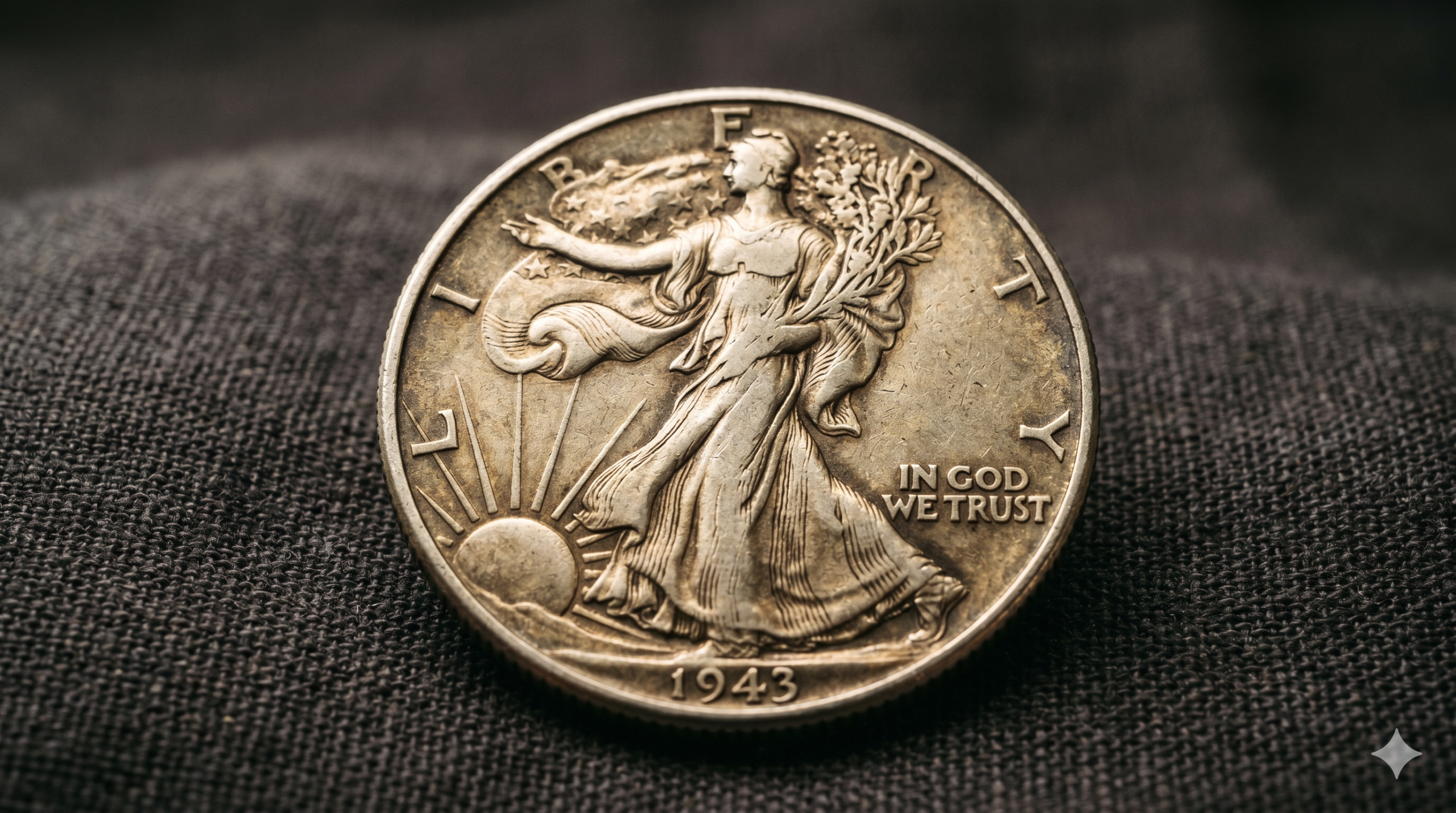
The Walking Liberty half dollar is widely considered the most beautiful coin ever produced by the U.S. Mint. Adolph A. Weinman’s design — Lady Liberty striding toward the rising sun, draped in the American flag — was so admired that the same image was revived for the American Silver Eagle bullion coin starting in 1986.
If you’ve inherited a collection or come across a Walking Liberty in a coin jar, the natural question is what it’s worth. The answer ranges widely — from a few dollars for a worn common date to many thousands for a high-grade key date. Here’s how to figure out which end of the range you’re closer to.
The fast answer
A Walking Liberty half dollar contains 0.3617 troy ounces of silver (90% silver content), so the absolute floor value of any Walker is its silver melt value. At current silver prices, that floor is meaningful — even a heavily worn common-date Walker is worth several times face value.
Above the floor, value depends on three things:
- Date and mint mark (some are dramatically scarcer than others)
- Grade (condition can multiply value 10x or 100x)
- Originality (cleaned coins are permanently devalued)
A common-date Walker in well-worn condition sits near melt value. A key-date Walker in mint state can fetch thousands. The spread is enormous, which is why date-by-date evaluation matters.
A brief history
The Walking Liberty half dollar was minted from 1916 to 1947. The series is typically divided into three production periods:
- Early period (1916–1921) — The first few years of the design, including several scarce key dates. Mintages were generally lower, and many coins were heavily circulated during the lean years of the late 1910s and early 1920s.
- Production gap (1922–1933) — No Walking Liberty half dollars were minted during this 12-year stretch. The Mint focused on other denominations.
- Late period (1934–1947) — Production resumed in 1934 and continued through 1947, when the Walker was replaced by the Franklin half dollar. This period accounts for the majority of surviving Walkers and is where most common dates come from.
Where to find the mint mark
This is one of the unusual features of the series, and it trips up casual collectors. Mint mark location moved during the series.
- 1916 and part of 1917: Mint mark appears on the obverse (front), just below “IN GOD WE TRUST” near Liberty’s lower right.
- Mid-1917 onward through 1947: Mint mark appears on the reverse (back), near the lower left, just to the left of the eagle’s tail feathers.
This matters because 1916 and the 1917 obverse-mintmark coins are scarcer and more valuable than their 1917 reverse-mintmark counterparts. Always check the obverse on early dates.
Mint marks you’ll see:
- (blank) — Philadelphia
- D — Denver
- S — San Francisco
Walking Liberty key dates and semi-keys
These are the dates that separate a common Walker from a notable one:
True key dates:
- 1916 (all mints, especially 1916-S) — Low mintages and a single year of production at this design’s full size.
- 1916-D, 1916-S — Both scarce. The 1916-S in higher grades is particularly desirable.
- 1917-D obverse mint mark, 1917-S obverse mint mark — These early-1917 coins with the obverse mintmark are notably scarcer than their reverse-mintmark counterparts.
- 1921 (Philadelphia) — Only 246,000 minted. One of the lowest mintages of the series.
- 1921-D — Even lower mintage at 208,000. The lowest-mintage Walker. Genuine examples in any grade carry significant value.
- 1921-S — Higher mintage than 1921-D but still scarce, especially in higher grades.
Semi-key dates:
- 1919, 1919-D, 1919-S — Scarce in mid-to-high grades.
- 1938-D — The lowest-mintage Walker of the late period. Always commands a premium.
Common dates:
Most Walkers from 1934–1947 (excluding 1938-D) are common dates. They were minted in millions and survive in quantity. In well-worn condition, they’re priced close to melt value. In mint-state grades, premiums grow but remain modest compared to the keys.
Realistic value ranges (general guidance)
Specific prices fluctuate with silver spot price and collector demand, but here are realistic frameworks for what to expect at a fair offer. These are buying ranges — what a seller might receive — not retail prices.
Common date Walkers (1934–1947, excluding 1938-D)
- Heavily worn (Good to Very Good): Near silver melt value
- Lightly worn (Fine to Extremely Fine): Modest premium over melt
- About Uncirculated to low mint state: Notable premium, especially for cleaner surfaces
- High mint state (MS-65 and above): Significant premium, often many multiples of melt
Semi-keys (1919-D, 1919-S, 1938-D, others)
- Worn examples: Premium of several to many times melt
- Mint-state examples: Strong premiums, growing quickly with grade
Key dates (1916 issues, 1917 obverse mintmarks, 1921 trio)
- Even in well-worn condition, key dates carry meaningful premiums — sometimes hundreds of dollars on a coin that would otherwise be a melt-value piece.
- In mint-state grades, key dates can reach four and five figures.
If you have a coin you think might be a 1921 or 1921-D, don’t dismiss it because it’s worn. A heavily circulated 1921-D is still worth significantly more than a pristine common-date Walker.
Grading basics for Walking Liberty halves
Walkers are notoriously difficult to find well-struck. The design’s high relief — the same feature that makes them beautiful — meant the dies struggled to fully press the metal into all the details. Even mint-state Walkers often show weak strikes on Liberty’s hand, the eagle’s breast feathers, and the trees on the reverse.
A few general guidelines:
- Good (G-4) to Very Good (VG-8): Heavy wear. Most design detail flattened. Liberty’s outline visible but inner features merged.
- Fine (F-12) to Very Fine (VF-20): Moderate wear. Some detail visible in Liberty’s gown and the eagle’s wing.
- Extremely Fine (EF-40) to About Uncirculated (AU-50/55/58): Light wear only on the highest points. Most details sharp.
- Mint State (MS-60 and up): No wear at all. Differences within mint state come down to strike, luster, and contact marks.
For coins you suspect are mint state or high-grade keys, professional grading (PCGS, NGC) before selling is worth considering. The cost of grading is small relative to the value swing between grades on a key date.
The cleaning problem
A clean-looking, shiny coin is not what a buyer wants. Original surfaces — including natural tarnish, also called toning — are part of what gives a coin value.
Cleaning destroys this. Even gentle polishing leaves microscopic scratches and altered surfaces that an experienced buyer or grader can spot instantly. A cleaned key-date Walker is worth dramatically less than the same coin with original surfaces. A cleaned common-date Walker is barely worth more than melt.
If you’ve inherited Walkers from a relative who cleaned their collection, don’t despair — bring them anyway. They still have silver value, and not every coin in the collection will have been cleaned. But if you’re tempted to clean them yourself before selling: please don’t.
What to bring when selling
If you have a collection of Walking Liberty half dollars to sell:
- Bring everything, including coins you assume are common. Sorting takes minutes; missing a key date because you left it home is permanent.
- Don’t remove coins from professional grading holders (PCGS, NGC). The slab is part of the value.
- Keep coins in their original holders if they’re in 2×2 cardboard flips, plastic flips, or albums. Removing them for “presentation” is unnecessary and risks damage.
- Bring any paperwork that came with the collection — old appraisals, dealer receipts, inventory lists. Provenance can matter for higher-end coins.
Bottom line
The Walking Liberty half dollar is one of the most beautiful — and most accessible — pieces of classic American numismatics. Most Walkers are common dates worth modest premiums over silver melt. A few are major rarities worth thousands of dollars even in worn condition.
You don’t need to be an expert to know what you have. You just need to bring the collection to a qualified buyer and have it sorted, dated, and graded. The keys are easy to spot for someone who looks at Walkers every day.
Selling Walking Liberty halves
Premier Gold, Silver & Coin evaluates Walking Liberty halves at weekly buying events across the US. Bring the full collection — common, key, and everything in between — and we’ll walk through it with you, year by year. Offers are calculated transparently and paid by business check the same day. Sign up for notifications when we’re holding an event near you!