Morgan vs. Peace Silver Dollars: Which Is Worth More?
If you’ve inherited a silver dollar collection — or pulled a single hefty coin out of a drawer and wondered what you’ve got — there’s a good chance you’re looking at either a Morgan or a Peace dollar. They’re the two great American silver dollars of the late 19th and early 20th century, and they’re often kept together in the same coin tubes, the same albums, the same shoeboxes.
But they’re not worth the same thing. Not even close, in some cases. Here’s how to tell what you have and what it’s likely worth.
The fast answer: which silver dollars are worth more?
On average, Morgan dollars are worth more than Peace dollars. Morgan dollars were minted longer, in more varieties, and at more mint locations — which created more rare key dates and more demand from collectors. The most valuable Morgans run into the tens of thousands of dollars; the most valuable Peace dollars usually max out lower.
But the key dates dominate. A common-date Morgan is worth roughly the same as a common-date Peace dollar in the same grade. The big money on both series of silver dollars sits in specific years and mint marks. If your collection has the right dates, a Peace dollar can absolutely outvalue a Morgan dollar in the same condition.
So the real question isn’t “which series is more valuable” — it’s “what dates do you have, and what condition are they in?”
A quick history of both silver dollars
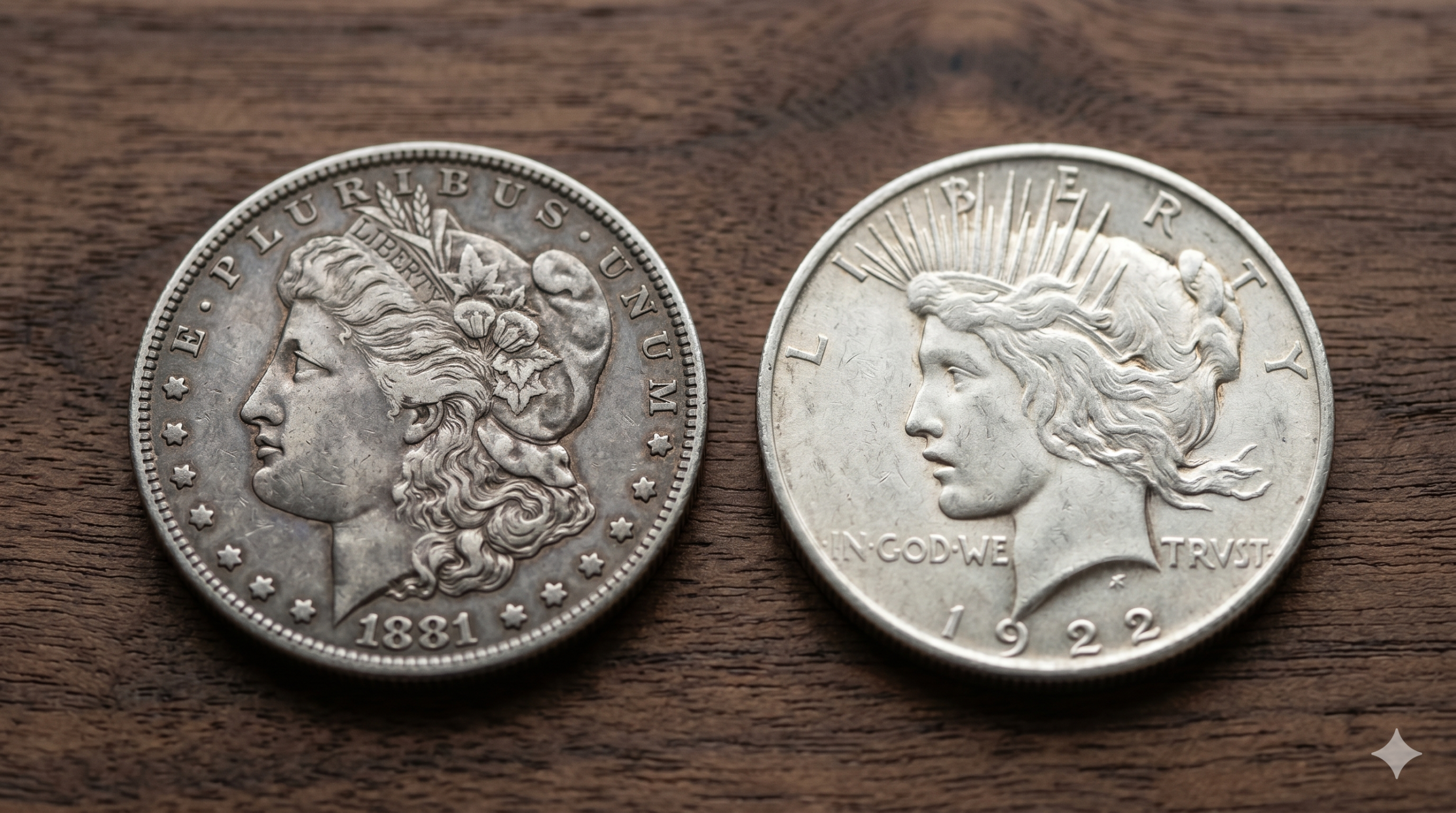
Morgan dollars (1878–1904, 1921) were designed by George T. Morgan, the assistant engraver at the U.S. Mint, after Congress passed the Bland-Allison Act to require massive purchases of silver. The result was 26 years of high-mintage silver dollars across five mint locations: Philadelphia (no mint mark), New Orleans (O), San Francisco (S), Carson City (CC), and Denver (D, only in 1921).
Production stopped after 1904 when silver reserves ran low. The Morgan was briefly revived in 1921 to comply with the Pittman Act, then immediately replaced.
Peace dollars (1921–1928, 1934–1935) were designed by Anthony de Francisci to commemorate peace after World War I. The reverse shows an eagle clutching an olive branch, with the word “PEACE” below. They were minted at Philadelphia, San Francisco, and Denver. The series has a notable gap — no Peace dollars were minted from 1929 through 1933 due to economic conditions during the Great Depression.
The 1921 Peace dollar was struck in high relief (deeper, more dramatic design) and is the only year of the series with that feature. From 1922 onward, the relief was lowered to extend die life.
Mintage matters: how silver dollars compare
A coin’s value is driven by scarcity (how few exist) and demand (how many people want one). Both series of silver dollars have common dates that exist by the millions and key dates where survival numbers are in the thousands or fewer.
Common-date Morgans in average circulated condition trade at modest premiums above silver melt value. Years like 1881-S, 1885, 1887, and 1921 were produced in enormous numbers and are easy to find.
Common-date Peace dollars trade similarly — 1922, 1923, 1924, and 1925 are all common dates, available in quantity in nearly every grade.
The melt value of a 90% silver dollar (both Morgan and Peace contain 0.7734 troy ounces of silver) is identical between the two series. So a common-date coin in well-worn condition is worth roughly the same regardless of which design.
The difference shows up at the key dates.
Morgan dollar key dates to look for
These are the dates that turn a Morgan dollar from a $30 coin into something significantly more valuable:
- 1893-S — The single most valuable common-issue Morgan. Even in worn condition, a genuine 1893-S can be worth thousands.
- 1889-CC — Carson City mint, low mintage, high demand.
- 1879-CC — Another scarce Carson City issue.
- 1895 (proof only, Philadelphia) — The famous “King of Morgan Dollars.” Only 880 proof examples were struck for Philadelphia. Any 1895 from Philadelphia is a major find.
- 1895-O and 1895-S — Companion dates to the 1895 proof, both valuable.
- 1903-O — Once thought rare, still commands premiums in higher grades.
- All Carson City (CC) Morgans — Any Morgan with a CC mint mark carries a premium beyond melt value, regardless of date.
Peace dollar key dates to look for
The Peace dollar series is shorter and has fewer key dates, but a handful are very desirable:
- 1921 (High Relief) — The only year of the high-relief design. Significantly more valuable than later years in every grade.
- 1928 (Philadelphia) — Lowest-mintage Peace dollar at just 360,649 struck. The key date of the series.
- 1934-S — Scarce in high grades. Worn examples are reasonable; mint-state pieces command strong premiums.
- 1924-S, 1925-S, 1927, 1934, 1935-S — Semi-keys that are worth more than common dates, especially in higher grades.
Grade is everything
The same coin in different conditions can vary in value by 100x or more. Silver dollars are graded using the Sheldon scale, running from 1 (barely identifiable) to 70 (perfect).
In broad strokes:
- Worn/circulated examples (grades roughly Good through Extremely Fine, or G-4 to EF-40) trade for moderate premiums above melt.
- About Uncirculated (AU-50 to AU-58) shows light wear on the highest points but most original luster intact. Values rise meaningfully.
- Mint State (MS-60 through MS-70) means no wear, only varying degrees of strike quality, luster, and surface marks. This is where values can multiply quickly — an MS-65 common-date Morgan can be 10x to 50x the value of the same coin in worn condition.
Don’t try to grade your own coins precisely. The differences between MS-63 and MS-65, for example, can mean hundreds of dollars on a common coin and thousands on a key date. Professional grading services (PCGS, NGC) exist for exactly this reason. If you have a coin you suspect is mint-state and possibly a key date, get it evaluated before selling.
A word on cleaning silver dollars
Never clean silver dollars. Not with silver polish, not with baking soda, not with a cloth, not by rinsing under water. Original surface — including dark toning that might look like tarnish — is part of what makes a coin valuable. Toning can actually increase value when it’s attractive (“rainbow toning” on Morgans, for example, can dramatically increase prices).
A cleaned coin is permanently devalued. Buyers and graders can spot cleaning immediately, even decades after the fact. If you’re tempted to “shine up” inherited coins before showing them to a buyer — don’t. Bring them as they are.
Varieties and errors
Both series have notable varieties that can add value:
Morgan varieties: VAM (Van Allen-Mallis) varieties are a deep specialty, but the broad strokes worth knowing — the 1878 “7 tail feathers” and “8 tail feathers” varieties, 1888-O “Hot Lips” doubled-die obverse, and various double-die obverses across years can carry significant premiums.
Peace varieties: The 1921 high-relief is the most important “variety” of the series. Beyond that, doubled-die issues on the obverse exist for several years but are less commonly traded.
If you have a coin with what looks like doubling, an unusual mintmark, or any oddity that doesn’t match a standard reference, don’t dismiss it — bring it to be looked at.
Bottom line: what are your silver dollars worth?
For common-date circulated coins (most Morgans 1878–1904 without CC mintmark, most Peace dollars 1922–1925), expect offers tied to silver melt value plus a modest premium for the design.
For key dates (the lists above), values can range from a few hundred dollars to many thousands, depending on grade and authenticity.
For uncertain cases — coins that look unusual, coins in old albums or holders, coins with paperwork suggesting they were once formally appraised — don’t make assumptions. The cost of having a buyer look at them is zero, and the upside of not missing a key date can be substantial.
Selling silver dollars
Premier Gold, Silver & Coin evaluates Morgan and Peace silver dollars at weekly buying events across the Midwest and Mid-Atlantic. Bring everything, including coins you assume are common — sorting takes a few minutes and can surface key dates that have been hiding in silver dollars collections for decades. Every offer is calculated transparently and paid by business check the same day. Find an event near you or sign up to be notified when we’re in your area.